
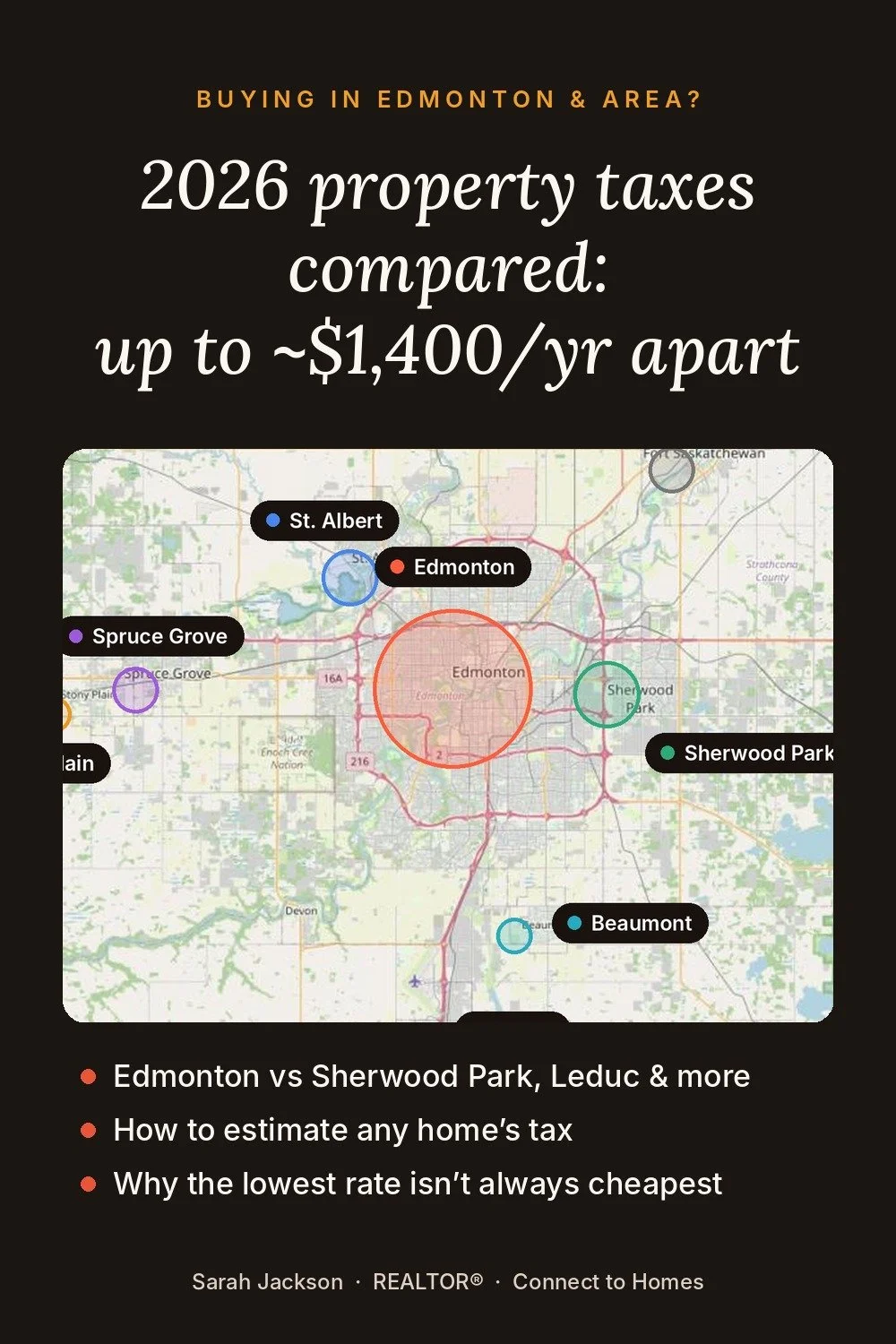
The same $450,000 home costs about $1,400 a year more in property tax in Edmonton than in Sherwood Park, and about $1,700 more in St. Albert, based on 2026 rates. That is more than $100 a month, every month, for as long as you own the home, and it never shows up in the list price.
If you are deciding between Edmonton and a neighbouring community, property tax belongs in your budget alongside the mortgage, utilities and commute. Here's how 2026 rates compare across the region, why they differ, and how to estimate the bill on any home in two minutes.
Part of my series on the 8 things to check so you don't regret buying in Edmonton. Watch the 30-second video version below, and save this post for your house hunt.
2026 property tax rates: Edmonton vs. surrounding communities
Each municipality in the Edmonton region sets its own residential tax rate every spring. The rate is applied to the home's assessed value, so the town you buy in can change your yearly bill by more than $1,000 on the same home.
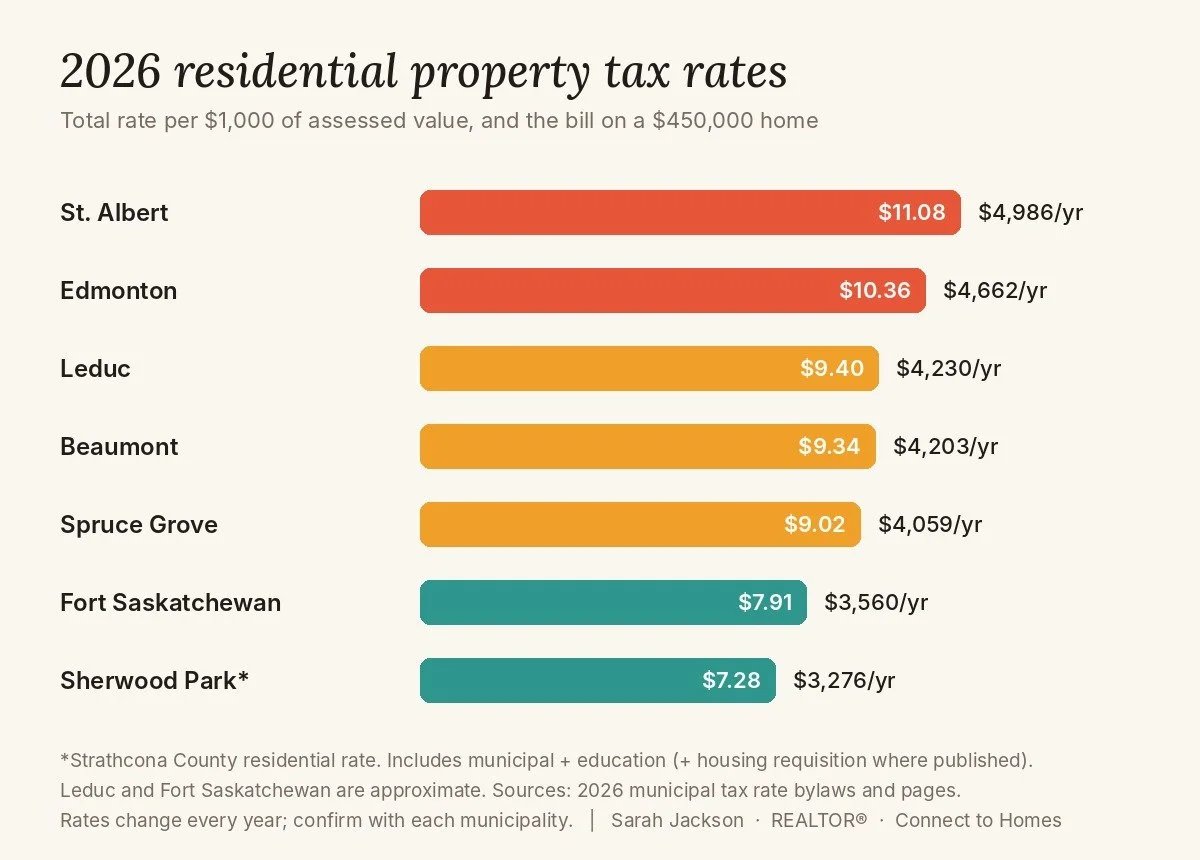
2026 total residential rate per $1,000 of assessed value, and the tax on a $450,000 assessment:
St. Albert: $11.08, about $4,986 a year
Edmonton: $10.36, about $4,662 a year
Leduc (approx.): $9.40, about $4,230 a year
Beaumont: $9.34, about $4,203 a year
Spruce Grove: $9.02, about $4,059 a year
Fort Saskatchewan (approx.): $7.91, about $3,560 a year
Strathcona County / Sherwood Park: $7.28, about $3,276 a year
Rates include the municipal and provincial education portions, plus the local housing requisition where the municipality publishes it. Leduc's total combines its published 2026 municipal rate (6.775) with the education and housing portions. Fort Saskatchewan's is worked out from the City's sample tax bill. Stony Plain had not published a residential total we could confirm at the time of writing, so check its site directly.
What the gap looks like over time
On a $450,000 assessment, the difference between the highest rate above (St. Albert) and the lowest (Sherwood Park) is about $1,710 a year. Over a 5-year mortgage term that is roughly $8,550, and over 10 years roughly $17,100, before any rate increases. Even between Edmonton and Sherwood Park, the gap is about $1,386 a year. That is real money, but it is only one line in your budget, which is why the next section matters.
Why the rates differ, and why the lowest rate isn't always the cheapest
Who else pays tax. Municipalities with a lot of industry can collect more from business and industrial property, which takes pressure off homeowners. Strathcona County, home to Refinery Row, is the best-known local example.
What you get. Transit, recreation centres, snow clearing and policing levels all differ, and so do utility bills, which are charged separately.
Your commute. A lower tax bill can be eaten up by fuel, a second vehicle or extra hours on the road if you work downtown.
Assessed value, not price. Your bill is the rate times the home's assessed value, which can be higher or lower than what you pay for it.
Rates change every year. Edmonton's 2026 tax increase for a typical home was 8.0% (City of Edmonton). Budget for increases, not just this year's number.
How to estimate a home's tax bill in 2 minutes
Find the assessed value. Look on the listing, or use the municipality's assessment search (Edmonton's is on edmonton.ca).
Find the total residential rate on the municipality's tax rate page. It is often written in mills, which means dollars per $1,000 of assessed value.
Multiply: assessed value ÷ 1,000 × rate. For example, $450,000 ÷ 1,000 × 10.36 = $4,662 a year, or about $389 a month.
Ask the seller for last year's tax notice to check your math.
Lenders include property tax in your mortgage qualification, so a lower bill can also make a little more room in your budget.
Your property tax checklist
☐ Found the home's assessed value
☐ Looked up the municipality's 2026 total residential rate
☐ Estimated the yearly and monthly tax
☐ Compared at least one neighbouring community
☐ Factored in utilities and commute costs, not just tax
☐ Asked the seller for last year's tax notice
This is 1 of the 8 things I check with every buyer.
Read the others: flood maps & LRT construction and what to check in an older home.
Frequently asked questions
-
Of the municipalities compared here for 2026, Strathcona County (Sherwood Park) had the lowest total residential rate at about $7.28 per $1,000 of assessed value. St. Albert had the highest at about $11.08, followed by Edmonton at about $10.36.
-
Based on 2026 rates, yes. St. Albert's total residential rate is about $11.08 per $1,000 of assessed value, compared with about $10.36 in Edmonton. On a $450,000 assessment, that is roughly $324 more a year in St. Albert.
-
Divide the assessed value by 1,000 and multiply by the total residential rate. At Edmonton's 2026 rate of about $10.36 per $1,000, a $450,000 assessment works out to about $4,662 a year.
-
Strathcona County collects significant tax from industrial and business property, including Refinery Row, which helps keep the residential rate lower. Services, utilities and commute costs also differ, so compare the full cost of living, not just the tax rate.
-
A mill rate is the tax charged per $1,000 of assessed value. A rate of 10 mills means $10 of tax for every $1,000 of assessment.
-
They usually change every year. Edmonton's 2026 increase for a typical home was 8.0%. Check the City's budget news each spring.
Sources
Map data © OpenStreetMap contributors
General information only, not tax or financial advice. Rates are 2026 residential rates and change yearly; confirm with each municipality.