
A home can have the perfect kitchen, the right price and a great school nearby, and still sit in a flood fringe or two blocks from a five-year LRT build. Neither shows up in listing photos. Both can affect your insurance, your resale value and your day-to-day life.
The good news: in Edmonton, you can check both in about ten minutes, for free, before you write an offer. This guide shows you exactly where to look, what the maps mean, and the questions I ask for my buyers.
This is part of my series on the 8 things to check so you don't regret buying in Edmonton. Watch the 30-second video version below, and save this post for your house hunt.
1. Flood risk: is the home in a floodway or a flood fringe?
The North Saskatchewan River is one of the best things about living in Edmonton. It is also the reason some river-valley homes carry a flood designation. The Government of Alberta maps these areas in its free Flood Awareness Map, and every buyer looking near the valley should check it.
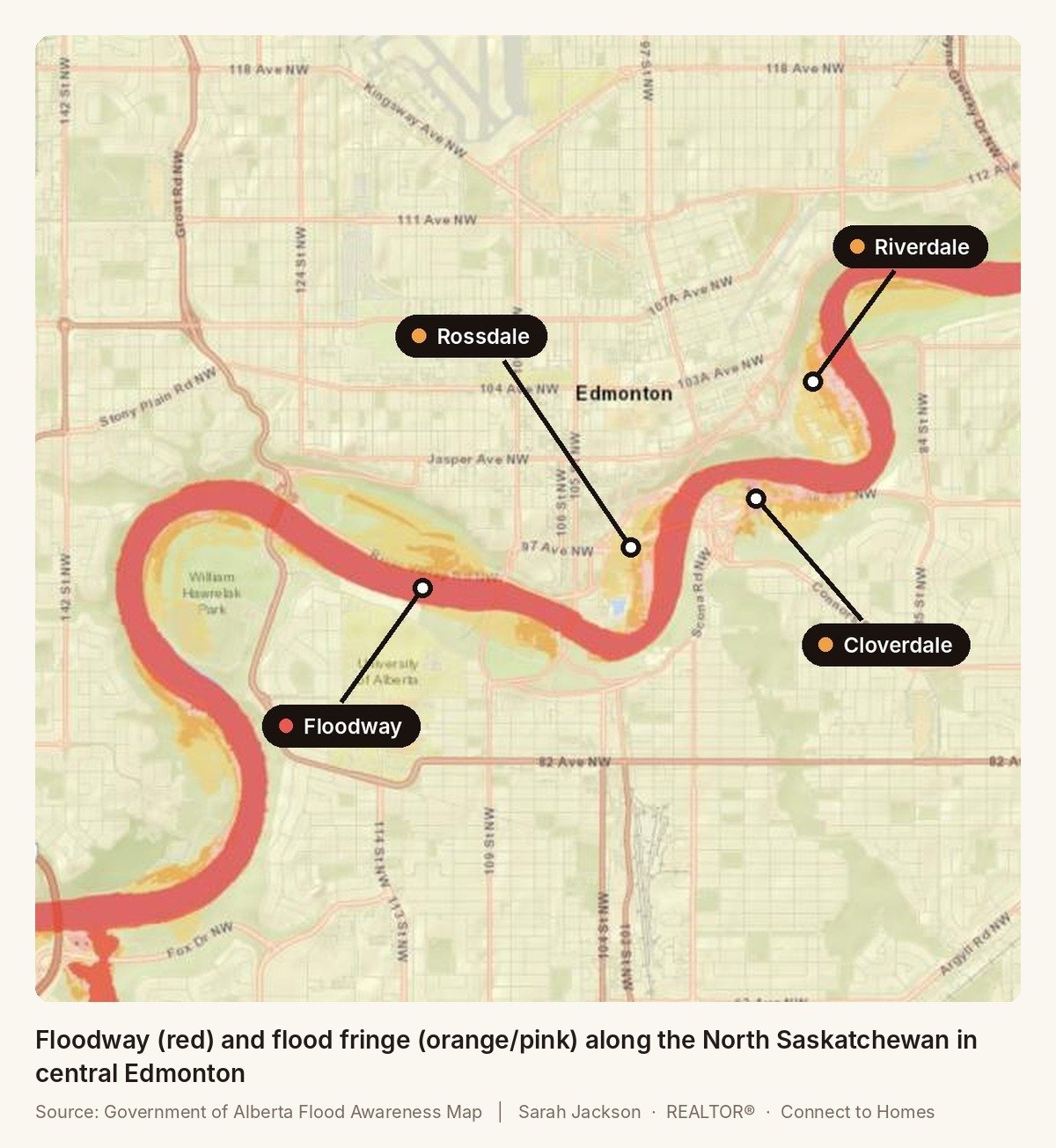
The map uses two main zones, based on Alberta's 1:100 "design flood": a flood with a 1% chance of happening in any given year (Government of Alberta).
Floodway: the highest-hazard area, where design-flood water is deepest, fastest and most destructive. Expect the most questions from insurers and the tightest rules on future additions or rebuilds.
Flood fringe: the rest of the flood hazard area, where water is usually shallower and slower. Common in mature river-valley neighbourhoods. Ask about past flooding, flood-proofing, the basement and insurance.
1:200 and 1:500 areas: areas that would flood only in larger, rarer events. Lower risk, but worth knowing about if you are finishing a basement.
A 1% chance a year sounds small. Over a 25-year mortgage, it adds up to roughly a 22% chance of at least one design-level flood. That is why it belongs on your checklist, not as a deal-breaker but as information you price in.
Central Edmonton on the provincial flood hazard map. The red band is the floodway; the orange and pink areas are flood fringe in Rossdale, Riverdale and Cloverdale.
How to check any Edmonton address for flood risk (in 10 minutes)
Open the provincial map. Go to floods.alberta.ca, choose Hazard, and search the address or zoom to the street.
Read the colour under the lot, not just the street. Floodway is red and flood fringe is pink or orange. Check the legend for "high hazard" or "protected" fringe.
Switch to Inundation or Likelihood to see how deep water could get and the cumulative risk over 30 years.
Check the seller's disclosure and ask directly: has the basement ever taken on water, from the river, a storm or a sewer backup?
Book an EPCOR flood prevention inspection once you own the home (free for City of Edmonton homes). More on that below.
Call your insurer before your financing condition comes off. Get a written quote that includes overland flood and sewer backup coverage.
Outside Edmonton? The same provincial map includes flood studies for many communities across Alberta, so search your address there too. Your municipality may also have local drainage maps.
Not near the river? Overland flooding still matters
The provincial map shows river flooding. It does not show the most common way Edmonton basements get wet: heavy summer storms that overwhelm drainage, or sewer water backing up through a floor drain. Low spots, older neighbourhoods and homes with older drainage connections are most exposed.
EPCOR, which runs Edmonton's drainage system, offers homeowners (EPCOR):
A free flood prevention home inspection for City of Edmonton homes. Interior-only from November to March; full inside-and-outside inspections when the weather allows, generally April to October.
A Backwater Valve Subsidy to help pay for a valve that stops sewer water flowing back into your basement. The inspection is required for pre-approval.
RainWise rebates for eligible stormwater projects on your property.
Questions to ask before you buy
Has the home ever had water in the basement? When, and what was fixed?
Is there a backwater valve and a sump pump? When were they last serviced?
Does the lot slope away from the house, and do the downspouts drain at least 2 m out?
Are there water stains, new drywall at floor level or a dehumidifier running in the basement?
Can the home get overland flood and sewer backup coverage? These are usually optional add-ons, and price and availability vary by address and insurer.
3. LRT and major construction: what's being built near the home?
Edmonton is in the middle of its biggest LRT expansion. That is great news for future commutes and, often, for long-term values near new stations. But living beside an active build for several years means detours, noise, dust and harder access, and it is easy to miss if you view a home on a quiet Sunday.
[ADD IMAGE: p1_vlw_map.jpg — alt text: Map of the Valley Line West LRT route from downtown Edmonton to Lewis Farms]
Valley Line West runs about 14 km from downtown to Lewis Farms (route drawn approximately).
Valley Line West is the big one for west-end buyers. The City describes the route as running from downtown along 102 Avenue, north on 107 Street and west on 104 Avenue, through Glenora and down Stony Plain Road to 156 Street, then south to 87 Avenue. From there it passes the Misericordia Hospital and West Edmonton Mall on an elevated guideway and continues west of Anthony Henday Drive to Lewis Farms (City of Edmonton). Construction is expected to be complete in 2028, with testing to follow before it opens (City of Edmonton).
[ADD IMAGE: p1_lrt_timeline.jpg — alt text: Timeline of Edmonton LRT projects from 2023 to 2030]
Valley Line West: under construction; complete in 2028, then testing. Watch: downtown, Glenora, Stony Plain Road, Jasper Place, Meadowlark, West Edmonton Mall, Lewis Farms.
Capital Line South: major construction began in 2025 along 111 Street; expected to take 4–5 years, then testing. Watch: the 111 Street corridor south towards Heritage Valley.
Metro Line Northwest (Phase 1): opened January 20, 2024 (NAIT/Blatchford Market).
Valley Line Southeast: open since 2023, Mill Woods to downtown.
Source: City of Edmonton – LRT projects
Living near the LRT: the upside and the trade-offs
Being near a future station is not good or bad on its own. It depends on how you live, how long you plan to stay, and exactly how close the home is.
During construction: you may buy before the station opens and the area is fully "discovered", but expect detours, lane closures, noise, dust and harder parking, often for several years.
Once it opens: car-light living, a faster commute downtown and new shops nearby, along with train noise and crossing bells near the line and more foot traffic.
Long term: the City plans to focus new homes and businesses in station areas, which means more density and change nearby, including taller buildings on main corridors.
My rule of thumb: a 5–10 minute walk to a station is often the sweet spot. Backing directly onto the tracks or a busy station entrance is a different trade-off. Visit at rush hour on a weekday, not just at your Saturday showing.
Check before you buy: the City's LRT construction updates page for closures near the address, and ask whether any road, sewer or utility work is planned on the street.
Your pre-offer checklist
☐ Looked up the address on the Alberta Flood Awareness Map (Hazard view)
☐ Asked the seller about any past water in the basement
☐ Confirmed a backwater valve and sump pump, or budgeted for them
☐ Got an insurance quote that includes overland flood and sewer backup
☐ Checked the City's LRT and construction pages for work near the address
☐ Visited at weekday rush hour and in the evening
☐ Walked to the nearest current or future LRT station and timed it
These are 2 of the 8 things I check with every buyer. The others: what can be built next door, flight paths and rail lines, industrial neighbours, the Real Property Report, the age of the home, and property taxes by municipality. My next post covers the age of the home and property taxes.
[ADD IMAGE: p1_pin.jpg — alt text: Pinterest pin: 2 things to check before you write an offer in Edmonton]
Frequently asked questions
How do I know if a house in Edmonton is in a flood zone?
Search the address on the Government of Alberta's free Flood Awareness Map at floods.alberta.ca and choose the Hazard view. Red areas are floodways, and pink or orange areas are flood fringes. Then ask the seller and your insurer about past flooding.
What is the difference between a floodway and a flood fringe in Alberta?
The floodway is where a 1-in-100-year flood would be deepest and fastest. The flood fringe is the rest of the flood hazard area, where water is usually shallower and slower. Floodway properties face the most questions from insurers and the tightest rules on rebuilding or adding on.
Which Edmonton neighbourhoods have flood fringe areas?
On the provincial map, river-valley neighbourhoods, including parts of Rossdale, Riverdale, and Cloverdale, show flood fringe areas. Always check the exact lot, because the designation can change from one street to the next.
Does home insurance cover flooding in Alberta?
Not automatically. Overland flood and sewer backup are usually optional add-ons. Get a written quote for the specific address before your conditions come off.
When will the Valley Line West LRT open?
The City of Edmonton expects construction to be complete in 2028. Testing has to happen before it opens, so no opening date has been announced.
Is it a good idea to buy near an LRT station in Edmonton?
It can be, especially within a 5–10 minute walk. Weigh the commute and amenities against construction disruption now and noise near the tracks later. Visit at rush hour before you decide.
Sources
Map data © OpenStreetMap contributors
This post is general information, not legal, insurance or engineering advice. Confirm details for any specific property with the municipality, your insurer and a qualified home inspector.